Autonomous pentesting · Sovereign AI · On-premise · Air-gap ready
An autonomous AI red team for your network, on hardware you own.
Autonomous penetration testing for networks and infrastructure: Zero Hunt attacks your environment the way a skilled adversary would, proves every finding with evidence, and walks your team through the fix — continuously, on its own AI models, with a human in the loop, and without your data ever leaving your network.
- specialist AI agents
- 10
- validated attack skills
- 142+
- compliance frameworks worldwide
- 34
- calls to an external LLM
- 0
Annual tests, signatures and spreadsheets cannot keep pace.
Attackers now use AI to find and weaponize weaknesses in hours. A yearly pentest, rule-based detection and hand-built compliance evidence describe last quarter's network, not today's.
A pentest is a snapshot
By the time the report arrives, the environment has changed: new assets, new vulnerabilities, new misconfigurations. Exposure has to be validated continuously — and proven, not estimated from a CVSS score.
Signatures only catch what is already known
Rule-based SIEM and NDR tools match known patterns. Novel command-and-control, living-off-the-land techniques and encrypted exfiltration pass underneath them.
Compliance evidence is assembled by hand
NIS2, DORA, ISO 27001, SOC 2, NIST, HIPAA, CMMC — regulators and auditors increasingly want continuous, signed evidence, not a binder assembled once a year.
Four capabilities, one appliance
Autonomous offensive testing, AI traffic analysis, continuous compliance evidence and AI-guided remediation, running together on private AI inside your perimeter — from proven finding to verified fix.
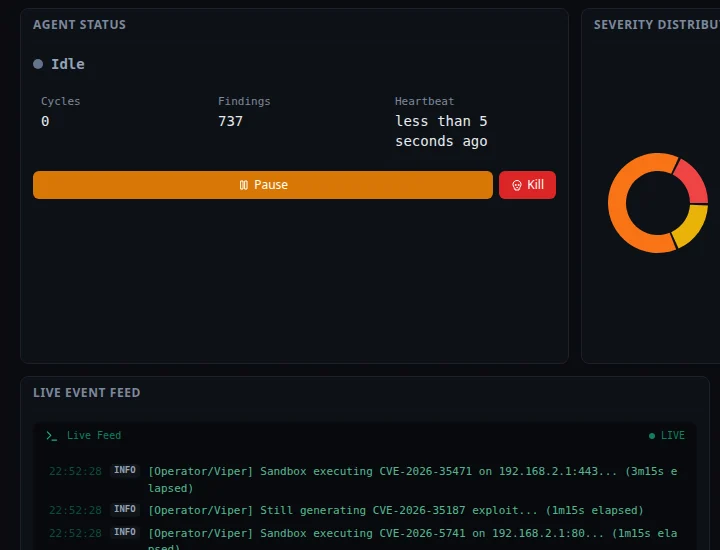
Agent status with pause and kill controls, and the live campaign feed — the operator stays in charge.
AI Generative Pentest
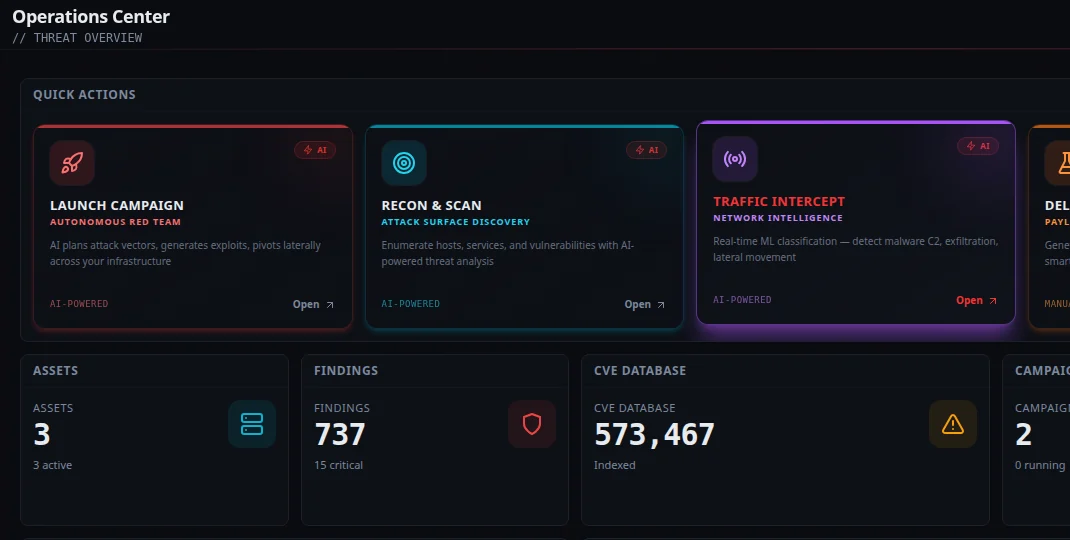
An autonomous red team, running continuously
Zero Hunt deploys a swarm of 10 specialist AI agents that autonomously discover, plan, and execute attacks against your infrastructure. The generative engine writes custom exploit scripts in real-time — not from a static database, but crafted specifically for your environment.
Recon, Vulnerability, Exploit, Web, Credential, Post-Exploit, Pivot, Tactic, Source Analyst and Report — coordinated by an AI Controller
LLM-powered code generation creates novel attack scripts for each target, not copy-paste from ExploitDB
AI Gym automatically evolves, tests, and backtests new exploitation techniques
Novelty validation engine identifies previously unknown vulnerabilities via CVE lookup + semantic similarity + LLM analysis
Compromised hosts become launch pads — the system automatically maps lateral movement paths
Every exploit runs in a disposable Docker container, optionally hardened with gVisor, and only inside the approved scope and autonomy level
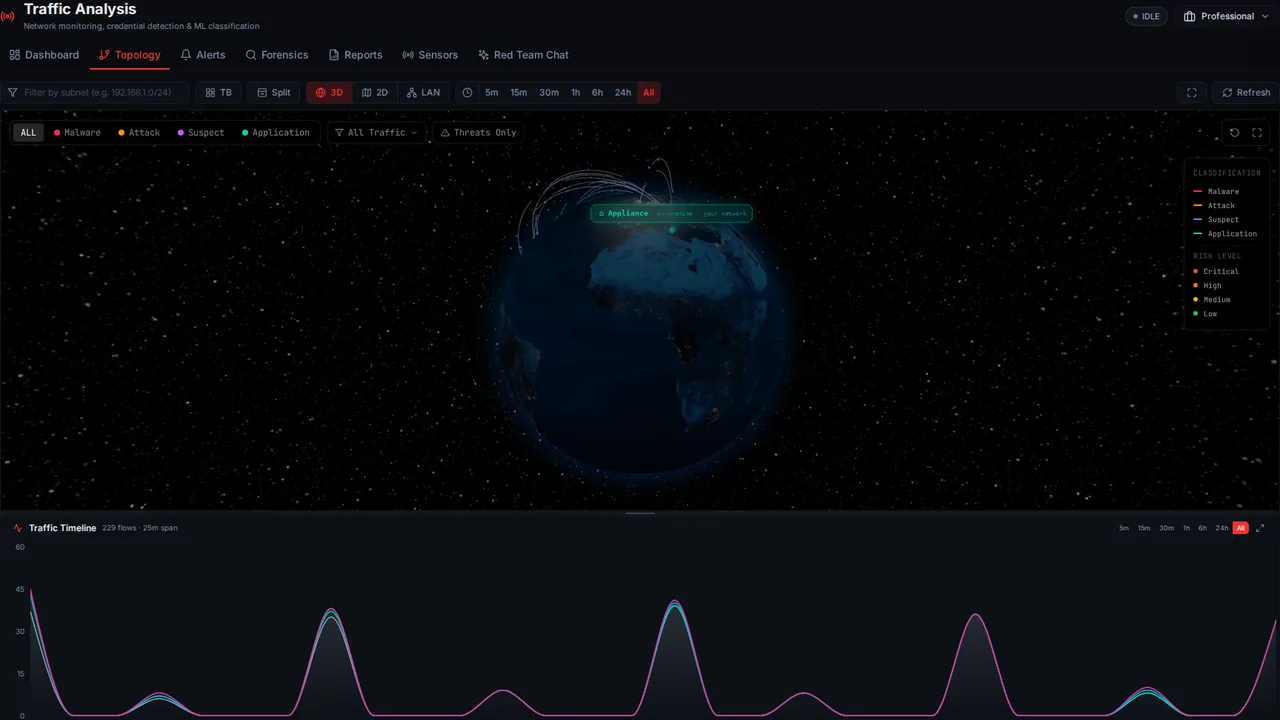
AI Traffic Analysis — 3D Threat Globe with real-time flow visualization
AI Traffic Analysis
Deep-Packet ML Intelligence at Wire Speed
A proprietary deep-learning architecture trained on billions of real-world PCAP sequences, running in real-time directly on the appliance GPU. Four parallel inference heads see what signature-based tools miss: novel C2 channels, encrypted malware beacons, ransomware staging patterns, data exfiltration, and anomalous lateral movement — without ever sending a packet to the cloud.
Deep-learning architecture trained on billions of labeled PCAP sequences — 4 inference heads: suspicious traffic, malware classification, attack type identification, application fingerprinting
Runs directly on the appliance GPU — no cloud, no external API calls. Every packet is classified as it traverses your network
On standard GPU-accelerated hardware — scales upward with higher-tier accelerators, no performance impact on production traffic
Behavioral analysis detects encryption-stage traffic patterns before files are locked
Identifies covert command-and-control traffic even over HTTPS, DNS tunneling, and domain fronting
Deploy sensors across network segments for complete visibility, including OT/ICS networks
Real-time geospatial visualization of traffic flows with threat correlation and ISP attribution
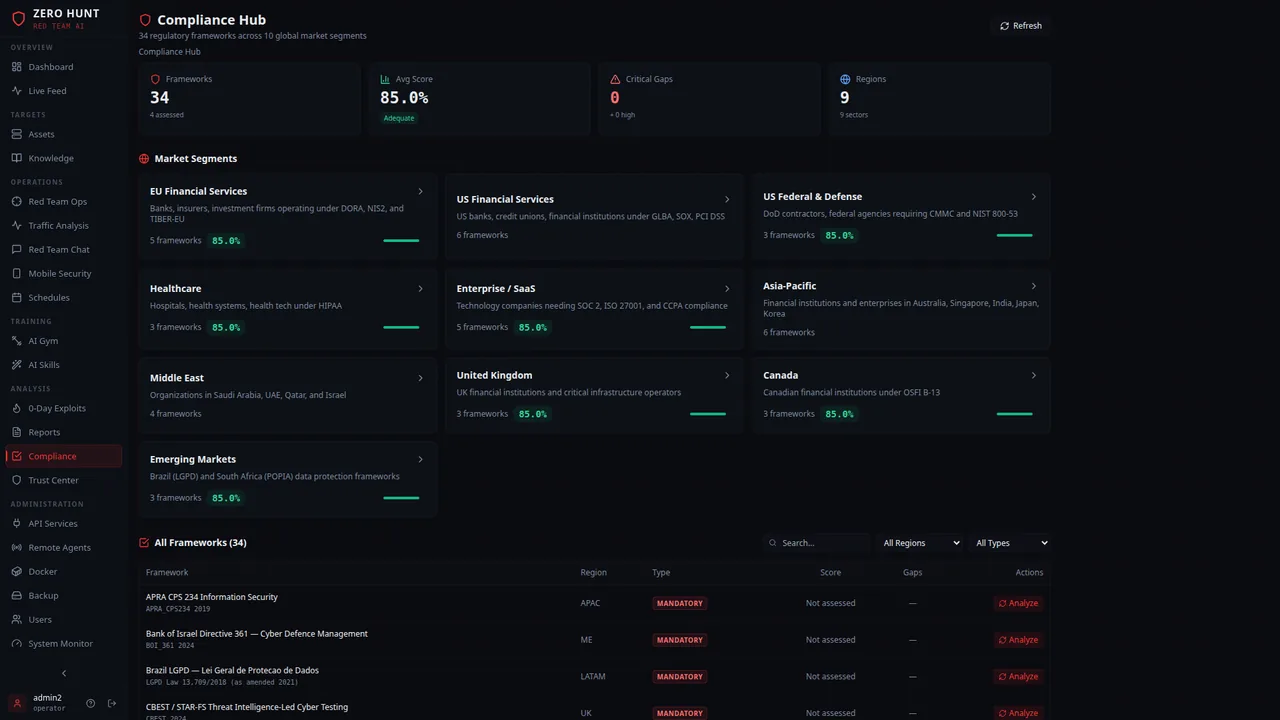
Compliance Hub — 34 frameworks, market segments, continuous gap analysis
Automatic Compliance
Continuous Assessment Across 34 Frameworks Worldwide
Zero Hunt automatically maps every finding, configuration, and evidence artifact to the compliance frameworks that matter to your business. NIS2, DORA, ISO 27001, SOC 2, PCI DSS, HIPAA, NIST CSF — all assessed continuously, not once a year.
NIS2, DORA, TIBER-EU, ISO 27001, SOC 2, PCI DSS, NIST CSF, NIST 800-53, CMMC, HIPAA, NYDFS Part 500, GLBA, SEC rules, CBEST, MAS TRM, Saudi NCA and 18 more — EU, US, UK, APAC, Middle East
Real-time control assessment with weighted scoring — not a checkbox once a year
Every scan, finding, and remediation is automatically mapped as compliance evidence
Cryptographically signed PDF reports with full chain-of-custody for auditors
Automated remediation tasks with priority scoring tied to compliance impact
One control satisfies multiple frameworks — reduce redundant audit work by up to 70%
Unauth RCE · web-01 :8080
SSH weak creds · 10.0.4.12
Exposed admin panel · db-02
How do I remediate the RCE on web-01 first?
Confirmed exploitable via the deserialization sink.
Patch to 2.4.6, drop :8080 at the edge, rotate the leaked token. Want the hardening script?
Remediation Advisor — prioritized fix plan + agentic chat grounded on the internal KB
AI Remediation Advisor
An Agentic Chat That Fixes, Not Just Finds
Finding the vulnerability is half the job. Zero Hunt closes the loop with an agentic advisor that turns a campaign's findings into a prioritized, step-by-step fix plan — then lets your team chat through each remediation in depth. Every answer is grounded on an internal knowledge base of exploitation techniques, CVE intelligence, and the engine's own evidence, so the guidance is specific to what was actually proven exploitable on your estate.
Findings are ranked by real, demonstrated risk — exploited and verified first — so your team fixes what matters before what's merely theoretical
A conversational AI that reasons over the campaign, pulls in the evidence it needs on demand, and walks you through each fix interactively — not a static report
Every recommendation is RAG-anchored to a curated knowledge base of attack techniques, CVE intelligence, and the engine's own findings — no generic, hallucinated advice
Remediation covers only findings proven exploitable (verified / exploited). Unconfirmed noise is excluded, so effort goes where the risk is real
Ask the advisor to generate ready-to-run remediation and hardening scripts tailored to the specific finding and your environment
Each advisor session is bound to its campaign — the AI always knows exactly which hosts, services, and findings it is reasoning about
From the vulnerable line of code to a proof of concept that runs.
A scanner compares signatures. Even most "AI" tools generate one script and stop there. Zero Hunt reads the exact version of the software you are actually running, finds the weakness in its source — including the ones no CVE catalog lists — and then keeps working the exploit, turn after turn, until it fires against your system for real.
How the proof gets built
Version-exact identification
It fingerprints the product AND the precise version you run — from generator metadata, headers, paths and JavaScript — then fetches that version of the source, from the public repository or from your own source mirror. Not the latest one, which may already be patched.
The weakness in the source
A taint scan follows request input to the sinks it can reach: SQL, command execution, path traversal, SSRF, deserialization, unauthenticated upload and actions. What comes back is the request shape — the action, the parameters, the handler — not a vulnerability name.
The Exploit Forge
A sealed container stays open while a coding agent writes the proof-of-concept, runs it against the target, reads what actually came back, corrects it and runs it again — stopping the moment the exploit demonstrably works.
What you get is not an opinion
A runnable proof-of-concept, filed against the campaign, alongside the before-and-after evidence of what it did. Not "you may be vulnerable" — this is the request, this is the effect it had, run it yourself.
The proof is also the fix
The same PoC is readable by the operator in chat and by the AI Remediation Advisor, because it names the exact request, parameter and source line the weakness lives on. No advisory describes a fix as precisely as the exploit that broke it.
Why the forge cannot be turned against you
No thread to your systems
The forge has no access to the host it runs on. Your files, your keys and the operator network simply do not exist inside it.
Injection neutralized, not hoped away
Every piece of downloaded source and every target response is sealed and labeled as data before the AI sees it. A booby-trapped comment is treated as evidence, never as an instruction.
No way out
It sits on a network with no route to the internet. It can reach the target under test and the reasoning model — nothing else. There is no channel to send a byte anywhere it should not go.
Least privilege, hard ceilings
Stripped of every system capability, unable to escalate, under fixed memory, CPU and process limits — and destroyed the instant the work is done.
This is the difference between a demo and something you can put inside a bank: the generative power of an AI that writes exploits, wrapped in a containment model designed by people who assume the code under examination is hostile — because it is.
Human in the loop
Autonomous when you want it. Supervised when it matters.
Every campaign runs at an autonomy level you choose, and collaborative mode can also pause it at the decision points you pick — before exploitation, pivoting or planning — until an operator approves, denies or redirects. Anything outside the chosen level waits for a person, and every approval, action and verdict is recorded.
1
Observe
Passive only; any active scan needs approval.
2
Light
Scanning; exploitation and credential tests need approval.
3
Standard
Credential testing; exploitation and availability tests need approval.
4
High
Exploit verification; availability tests need approval.
5
Full
Full assessment in a scheduled window, chosen explicitly.
Review before anything risky runs
A proof of concept the level does not allow goes to a review tab. Running it takes recorded consent, a fresh scope check, a per-script permission and a lock on the host.
A signed record of who did what
Every execution — by an agent or an operator — writes a signed row with its identity, target and outcome, and lands in the evidence chain.
A stop control that works
Operators can pause or stop a campaign at any time, and the final verdict on every finding is theirs.
Black box or gray box, by design
Campaigns start black-box — no credentials, no source. Gray-box adds authenticated testing and source-informed analysis when you provide them.
An AI Team That Lives Inside Your Walls.
Zero Hunt is not a cloud service. It is an AI security team that runs entirely inside your perimeter — on your hardware, on your network, on private AI, under your control. No customer data goes to a third party, nobody outside can switch it off, and the cost does not grow with every token the agents use.
Same intelligence as the best external red team — but it lives with you, answers only to you, and never leaves the building.
Why on-premise and private AI: data, control, cost — and who has to →
Powered by ZeroHunt Apex
Zero Hunt runs on ZeroHunt Apex — our own family of sovereign offensive-AI models, fine-tuned in-house on real exploit intelligence and executed 100% inside your perimeter. While other vendors wrap third-party cloud LLMs that refuse offensive work and send your data outside, we own the weights. Two tiers, the same red-team brain: choose efficiency or maximum capability.
ZeroHunt Apex
27BOn-Premise Flagship
The red-team model that runs inside your perimeter.
A 27-billion-parameter model fine-tuned for autonomous offensive security. Compact enough to run entirely on-premise — air-gappable, no data ever leaves your network — yet trained to reason across the full attack kill-chain.
ZeroHunt Apex Pro
284BMaximum Capability
Frontier-scale reasoning for the hardest targets.
A 284-billion-parameter model for the most demanding engagements. Deeper multi-step reasoning, broader exploit coverage and stronger novel-vulnerability discovery — for higher-tier appliances and sovereign private-cloud deployments.
A security tool on rented AI inherits someone else's rules
Most "AI security" products call a third-party cloud LLM. Your data leaves on every call, the provider decides what the model will and will not do, and the bill grows per token. Owning the models removes all three constraints.
Others — static tools + third-party cloud LLM
ZeroHunt Apex — models we fine-tuned and own
Trained on curated offensive intelligence — not scraped text
A proprietary, hand-curated corpus
Both models share the same training foundation: a proprietary corpus of ~130,000 high-signal offensive-security examples, assembled from a dozen-plus independent streams and refined through a rigorous data pipeline.
- ~130,000 curated examples
- Over 145,000 raw examples collected, then reduced via near-duplicate removal (MinHash) — variety, not repetition.
- Verified quality
- Deterministic + LLM-judged filters strip refusals, truncation and templated boilerplate. Uniqueness is measured on the answer body, so semantic filler never reaches training.
- Grounded in reality
- Derived from real exploit code, live CVE intelligence, detection rules, attacker tooling and battle-tested red-team methodology — not generic synthetic chatter.
- Full kill-chain coverage
- Reconnaissance, web exploitation, privilege escalation, payload construction, post-exploitation, threat intelligence and exploit-script coding.
- Eval-clean
- Decontaminated against every benchmark we test on, so our internal evaluations measure skill, not memorization.
A Complete Security Appliance
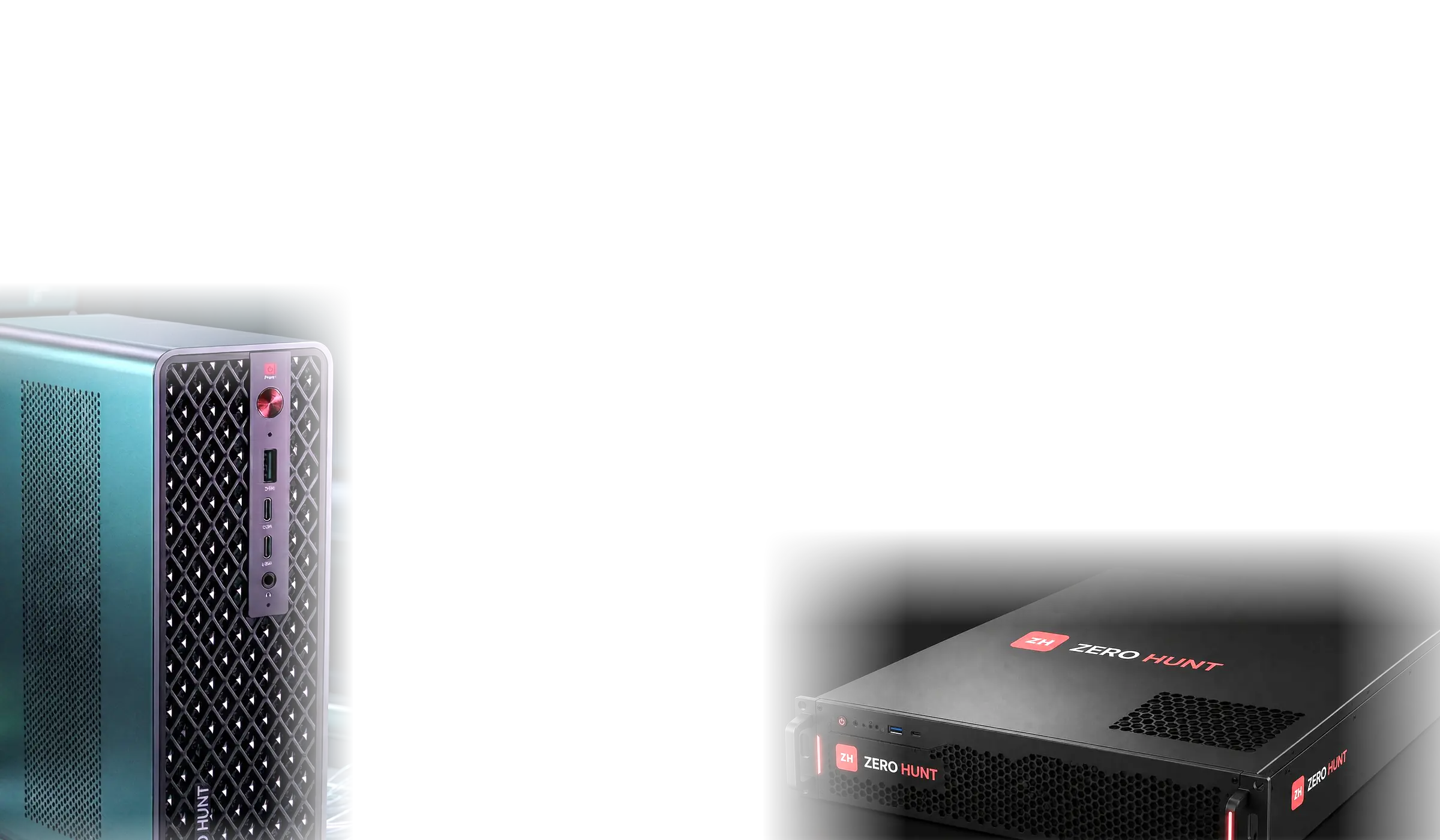
Zero Hunt is not just software — it's a purpose-built appliance combining dedicated AI hardware and a pre-configured security platform. You rack it, connect it to your network, and it immediately becomes an autonomous member of your security team. Nothing leaves your perimeter.

Desktop appliance
For branch offices, single sites and smaller organizations. Arrives pre-configured and hardened: power it on, authorize a scope, and the red team starts working.
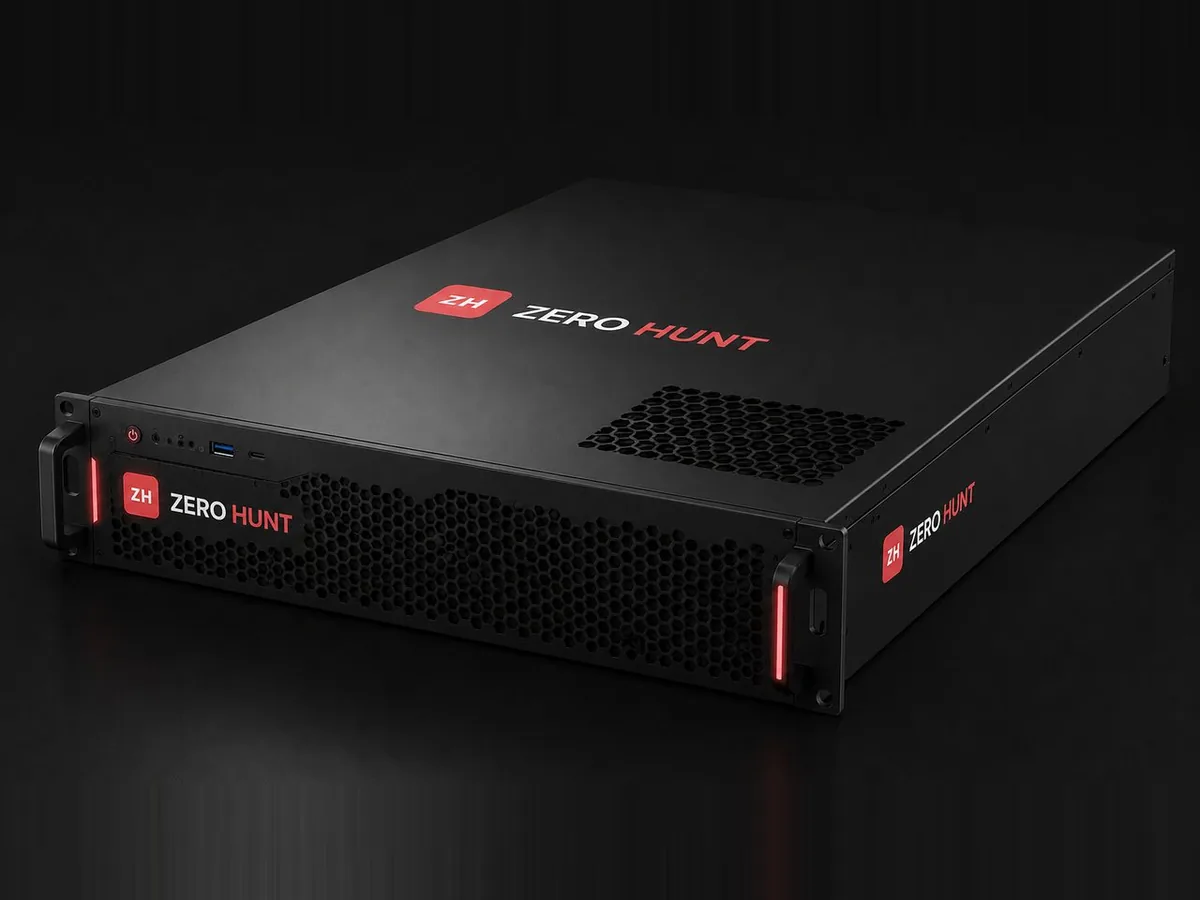
2U rack appliance
For enterprises, data centers and multi-site perimeters. Higher-tier GPUs for wire-speed traffic analysis and more campaigns running at the same time.
Same software on both units. Air-gapped deployment is supported on either.
Dedicated AI Hardware
GPU-accelerated inferenceShips with dedicated GPU accelerators running our proprietary traffic-analysis model (trained on billions of PCAP sequences) and LLM-driven exploit generation — baseline 2.7+ Gbit/s, scaling with higher-tier hardware.
On-Premise Only
Your network, your dataNo customer data leaves the appliance and no external LLM API is involved. Connected, it only fetches signed updates, public threat intelligence and, for gray-box analysis, published source code; in air-gap mode nothing goes out at all — the mode classified and regulated environments use.
Pre-Configured Software Stack
Zero-touch deploymentFastAPI backend, React dashboard, PostgreSQL + pgvector, Redis, sandboxed Docker execution — all baked in. Plug it in, onboard your network, start hunting.
Sandboxed Execution
Isolated by designEvery exploit runs in an ephemeral Docker container with optional gVisor hardening. The appliance itself is hardened — the attacks never touch the host OS.
Ship
Appliance arrives pre-configured and hardened
Rack
Install in your datacenter, connect to the network
Hunt
Autonomous security operations begin immediately
Your Internal Surface and Everything You Expose to the World.
Zero Hunt's first job is continuous assessment of the infrastructure inside your perimeter. But your attack surface doesn't stop at the firewall. The same resident AI team can drive full dynamic application security testing (DAST) against the public endpoints, web apps, APIs and appliances you expose to the internet — including assets you run on public cloud.
Internal Integrity
Always-on validation of the infrastructure inside your perimeter — the continuous assessment that keeps your network honest, day after day.
Public-Facing Coverage
On demand, the same engine pivots outward to test the web apps, portals, APIs and appliances you publish to the internet — the surface real attackers actually reach first.
What the DAST Engine Does
Authenticated Testing
Drives real login flows and reuses the session, so it tests the app as a logged-in user — not just the public shell.
Cloud Provider Fingerprinting
Passively detects where an endpoint actually lives — AWS, Azure, Alibaba Cloud, GCP — and adapts the assessment profile accordingly.
API & OpenAPI Ingestion
Parses your API specs and exercises each endpoint with injection, IDOR and auth-bypass probes instead of testing blind.
Web App Exploitation
25+ web exploit skills: injection, IDOR, open redirect, CORS, security-header and misconfiguration testing on live targets.
Appliance & Edge Testing
Probes the gateways, VPN portals and management consoles you expose at the edge — the appliances attackers love.
Same Trust Boundary
It is still your own internal AI team reaching outward — not an outsourced cloud scanner with a copy of your data.
This is not a "public-only pentest" service like the cloud tools or external hacking teams you can never fully trust. It is the AI team that already lives inside your walls — now also watching the doors you leave open to the outside world.
Twelve concrete scenarios, from problem to outcome
Pick the one closest to your current conversation. Each pairs a real problem with the Zero Hunt workflow that resolves it, and the outcome to expect.
Replace the annual pentest with continuous validation
You pay €50-150k/year to a pentest contractor and the report is obsolete within weeks of delivery.
Catch ransomware during encryption, not after
You operate a hospital, a manufacturer, or any 24/7 environment where Q1 2026 median time-to-impact is under 48 hours and the encryption phase, once started, is over in 90 minutes.
Produce NIS2 Article 23 incident evidence as a byproduct of operations
You are an essential or important entity under NIS2 (in Italy, decreto legislativo 138/2024). Every significant incident triggers a 24-hour early warning, a 72-hour notification and a final report within a month, counted from when you become aware of it.
Fix what was proven exploitable, in the order that matters
Your last assessment produced hundreds of findings, and your team can close a few dozen this month.
How Zero Hunt compares with the tools buyers shortlist
Side by side with automated pentesting, network detection, compliance platforms and scanners. The difference is architectural: one on-premise appliance on private AI instead of several cloud services.
| Capability | ZERO HUNT | Pentera | Darktrace | Vanta | Rapid7 |
|---|---|---|---|---|---|
| AI Generative Penetration Testing | Yes | Partial | No | Partial | Partial |
| AI-Powered Network Traffic Analysis | Yes | No | Yes | No | No |
| Automated Compliance (34 Frameworks) | Yes | No | No | Yes | Partial |
| Unified Offense + Defense + Compliance | Yes | No | No | No | No |
| Autonomous 24/7 Multi-Agent Operation | Yes | Partial | Partial | No | No |
| Self-Evolving AI Skills (AI Gym) | Yes | No | No | No | No |
| Zero-Day Discovery & Validation | Yes | No | No | No | No |
| Agentic AI Remediation Advisor (Prioritized) | Yes | Partial | No | Partial | Partial |
| Offense → Defense → Compliance → Fix Loop | Yes | No | No | No | No |
| On-Premise / Full Air-Gap Deployment | Yes | Partial | Yes | No | Partial |
| Single Platform, No Tool Sprawl | Yes | No | No | No | No |
Key insight: Pentera does automated pentesting. Darktrace does network detection. Vanta does compliance. None combines all four — let alone an agentic advisor that walks your team through the fix. Zero Hunt puts autonomous offensive security, AI traffic intelligence, continuous compliance and AI-guided remediation on one on-premise appliance, on private AI.
Key insight: Pentera does automated pentesting. Darktrace does network detection. Vanta does compliance. None combines all four — let alone an agentic advisor that walks your team through the fix. Zero Hunt puts autonomous offensive security, AI traffic intelligence, continuous compliance and AI-guided remediation on one on-premise appliance, on private AI.
Based on publicly available product documentation, reviewed September 2026.
Want a deeper head-to-head?
Pick the comparison that matches the tool you are evaluating today.
Threat intelligence
21 intelligence sources, kept current on the appliance
Every campaign starts from current vulnerability, exploit and technique data, synced from the public sources below — or imported as offline update bundles when the appliance runs air-gapped. Nothing about your environment goes the other way.
Vulnerabilities
- NVD — NIST National Vulnerability Database
- MITRE CVE — CVE list
- CISA KEV — Known exploited vulnerabilities
- OSV — Open-source package advisories
- VulnCheck — Exploit maturity ratings
- EPSS — Exploit prediction scores
Exploits and proofs of concept
- Exploit-DB — Public exploit archive
- GitHub PoC — Proof-of-concept repositories
- Metasploit — Exploit module index
- Nuclei — Community detection templates
Techniques and detection
- MITRE ATT&CK — Enterprise, Mobile, ICS
- CAPEC — Attack patterns
- Atomic Red Team — Detection tests
- Sigma — Detection rules
- GTFOBins · LOLBAS — Living-off-the-land binaries
Enrichment
- NIST CPE — Software identification
- SecLists — Default credentials
- HIBP — Breached-password hash ranges, cached locally
- Fingerbank — Device fingerprints
- MaxMind GeoIP — IP geolocation
Also on the appliance: AI Gym: skills tested and evolved against vulnerable labs · Mobile assessment lab for iOS and Android · Knowledge base recalling every past run · Red Team Chat · Scheduled campaigns · Trust Center evidence portal.
What CISOs actually ask
The questions we hear most often on a first technical call — deployment, private AI, cost, control and compliance.
Is Zero Hunt really on-premise, or does it phone home?
Truly on-premise. The full stack — the AI models, embeddings, traffic model, evidence store and console — runs on the appliance inside your perimeter. No customer data leaves it, and there are no external LLM API calls. When connected, the appliance makes outbound requests only to fetch signed product updates, public threat intelligence (NVD, CISA KEV, EPSS and similar feeds) and, for gray-box analysis, the published source of the software version under test — which you can switch off or point at your own source mirror. Update-status reporting (release ID, status, timestamp) is opt-in. In air-gap mode nothing goes out: updates arrive as signed offline bundles and intelligence as offline imports.
What is private AI, and why does it matter for an AI red team?
Private AI means the models run on infrastructure you control. Zero Hunt runs its own models — ZeroHunt Apex (27B) on the appliance GPU, Apex Pro (284B) for higher-tier and sovereign deployments. An AI red team handles network maps, unpatched weaknesses and recovered credentials: with private AI none of it reaches a third party, and no external provider can refuse, throttle, change or switch off the capability your defense depends on.
How does the cost compare with AI tools billed per token?
Agentic security testing is token-hungry: an autonomous campaign makes thousands of model calls, each with thousands of tokens of context, so metered AI gets more expensive the harder and longer it works. On the appliance the models run on hardware you own: a flat cost, 24/7, whether you run one campaign or a hundred.
How is the generative pentest engine different from a tool that runs Nuclei or Metasploit?
Tools like Nuclei and Metasploit execute curated modules from a static library. Zero Hunt's agents write new exploit code for each target with local models and validate every new skill in a sealed AI Gym (Vulhub, NYU CTF Bench, Cybench) before it reaches production — and, where authorized, turn a weakness found in the source of the exact version you run into a runnable proof of concept.
Is there a human in the loop?
Yes, as much as you want. Campaigns run at one of five autonomy levels, from passive observation to full assessment in planned windows; each level defines what waits for human approval. Actions outside the chosen level go to a review tab with recorded consent and a signed audit trail, operators can pause or stop any campaign, and the final verdict on every finding is theirs.
Does it test black-box or gray-box?
Both. Campaigns are black-box by default: no credentials, no source, only what your systems reveal. Gray-box adds authenticated testing with credentials you provide and source-informed analysis of the exact software version you run.
Which compliance frameworks are mapped out of the box — is it only for EU rules?
No. 34 frameworks across the EU, the US, the UK, Canada, Asia-Pacific, the Middle East, Latin America and Africa: NIS2, DORA and TIBER-EU; NIST CSF, NIST SP 800-53, CMMC, HIPAA, NYDFS Part 500, SOX and SEC rules; CBEST and the NCSC CAF; MAS TRM, APRA CPS 234 and RBI; Saudi NCA, UAE IA and Qatar NCSA; plus ISO 27001, SOC 2, PCI DSS, SWIFT CSP and CIS. Findings, scans and remediation are mapped automatically with cross-framework control deduplication, every record is signed at write time, and exported reports are ECDSA-signed.
What hardware does the appliance require?
It ships as a dedicated GPU appliance, pre-configured and hardened — a desktop unit for smaller sites and a 2U rack for enterprises and data centers. The baseline configuration delivers 2.7+ Gbit/s of AI traffic inference alongside the offensive engine; higher-tier GPUs scale throughput. You rack it, connect it to the segments you want covered, and run the onboarding wizard.
Does it work air-gapped?
Yes. Air-gap is a first-class deployment mode: no outbound connections; engine updates arrive as signed images loaded offline, and intelligence as offline bundle imports. Two capabilities depend on the internet and are switched off there: public-OSINT reconnaissance and downloading published source code for gray-box analysis, so those assessments run black-box. Networks that keep the appliance off the internet but give it access to their own source mirrors (GitHub Enterprise, GitLab, an artifact server) keep source-informed testing. It is designed for regulated and classified environments where vendor-cloud touch points are excluded by policy.
How does Zero Hunt fit into an existing SOC?
Two integration points. Findings, alerts and signed evidence flow out via REST, WebSocket and webhooks into your SIEM, SOAR, EDR or GRC. And the interactive Red Team chat lets a senior operator drive targeted tests on specific hypotheses in natural language, without repeating the reconnaissance the engine has already done.